
Home Buying Process in Bellevue, WA
Updated: May 26
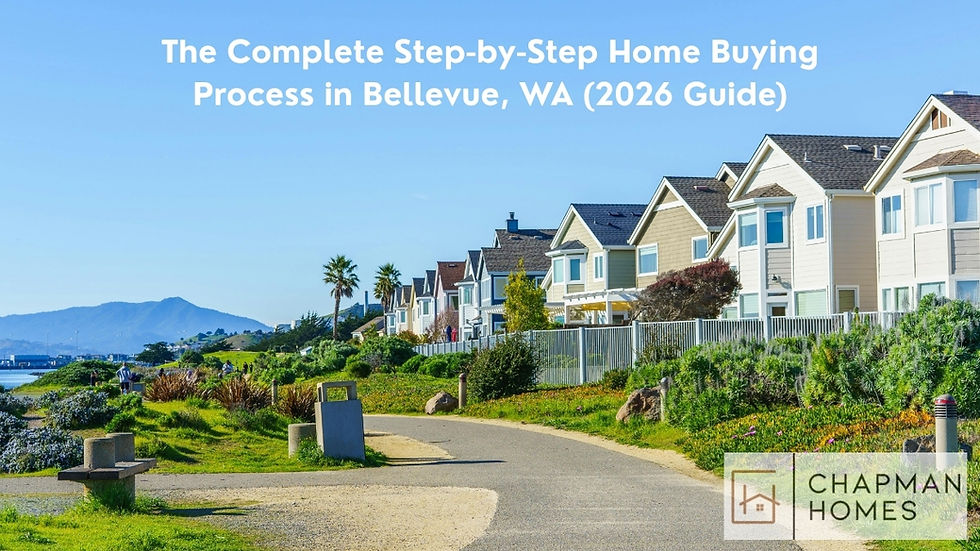
Buying a home in Bellevue is not like buying anywhere else in Washington. Prices are higher, competition is stronger, and the mix of tech jobs, top-rated schools, and limited inventory creates its own set of rules. If you are starting the home buying process in Bellevue, WA, you need a plan tailored to this specific market, not just a generic checklist. A 2023 National Association of Realtors report found that buyers who worked with a locally focused agent were significantly more likely to feel confident about their purchase two years later. This guide walks you through every stage of the Bellevue home buying process, what makes each step different here, and how to position yourself to succeed at every turn.
What Makes the Bellevue Home Buying Process Different
Bellevue's Market Has Its Own Rules in 2026
Bellevue sits at the center of the Eastside tech corridor, with strong demand from major employer populations pushing prices and competition well above most Washington markets. Homes in desirable neighborhoods often receive multiple offers quickly, especially when they are well-priced and move-in ready. Inventory tends to be tight in key micro-markets like West Bellevue, Medina-adjacent areas, and newer communities closer to transit and major employment centers, which means buyers need sharper preparation and faster decision-making than in slower Washington submarkets. This is a key reason the home-buying process in Bellevue feels very different from most other cities.
How Bellevue Compares to the Rest of Washington
Buyers across Washington go through the same general stages: pre-approval, home search, offer, inspection, appraisal, and closing. But the tolerances in Bellevue are different: higher price points, more aggressive terms, and less room for long inspection timelines or financing uncertainty. In some smaller Washington markets, it is still common to negotiate heavily or take your time. In Bellevue, a well-priced listing can go pending within days. A generic Washington home-buying checklist is simply not enough. You need a strategy tuned to Bellevue's price bands, neighborhood patterns, and seller expectations.
2026 Trends Bellevue Buyers Need to Watch
In 2026, Eastside buyers are navigating a combination of moderated but still meaningful mortgage rates, ongoing tech sector adjustments, and future light rail expansions that are reshaping where demand concentrates. Some buyers are stretching their search to surrounding cities like Bothell, Redmond, or Newcastle to find more space or value, while others trade square footage for commute and school advantages in Bellevue itself. These shifting conditions affect how you structure offers, which neighborhoods stay highly competitive, and how long it realistically takes to complete the full home buying process in Bellevue.
What the Bellevue Home Buying Process Helps You Navigate
Not Knowing What Is Realistic at Your Budget
Many buyers come in with a pre-approval number but no sense of what that actually buys across different Bellevue neighborhoods. Online affordability estimates are a starting point, but a local lender and agent can show you what a monthly payment actually buys in specific micro-markets. That means mapping out the payment you are comfortable with including principal, interest, taxes, insurance, and HOA dues; how your existing debts affect your debt-to-income ratio; and how long you expect to stay, since that influences what you can justify paying.
Building the Right Home-Buying Fund
In Bellevue, you will want to think in three buckets of cash: down payment, closing costs, and reserves. Down payments can range from lower-percentage options for certain loan programs to 20 percent or more to keep payments manageable. Closing costs include lender fees, title and escrow charges, recording fees, and prepaid taxes and insurance. Reserves are the funds remaining after closing for furnishing, minor repairs, and emergency savings. Because Bellevue prices are higher than most Washington markets, closing costs and recommended reserves can be meaningfully larger than statewide averages, and local lender estimates will always be more accurate than generic online numbers.
Choosing the Right Loan for a High-Price Market
Most Bellevue buyers end up with conventional loans, especially at higher price brackets, but FHA, VA, and jumbo options are also common depending on budget and down payment. FHA may help first-time buyers with lower down payments but can be harder to win with in hot segments because of upfront mortgage insurance and stricter property standards. Jumbo loans become more relevant above certain price thresholds common in West Bellevue or Medina-adjacent neighborhoods. In 2026, some buyers also consider adjustable-rate mortgages to secure a lower initial payment, especially if they expect to sell or refinance within a certain timeframe. The key is to model both fixed and adjustable options with realistic timelines. If an adjustable-rate loan exposes you to much higher payments before you plan to move, the short-term savings may not be worth it. Your agent and lender should align loan choice with your target price band and neighborhood competitiveness so financing never holds your offer back.
Accessing First-Time Buyer Programs Without Losing Competitiveness
Washington offers state-level down payment assistance and first-time buyer programs that pair with certain loans, and local lenders frequently work with these for Eastside buyers. In a high-cost area like Bellevue, assistance can help bridge the gap between savings and the required down payment, but you will need to factor in income limits and purchase price caps, as well as how competitive your offer appears to sellers when using certain programs. Pairing assistance with a strong pre-approval and a well-communicated offer strategy helps mitigate seller concerns and keeps the Bellevue home-buying process on track.
Getting Pre-Approved the Right Way

In Bellevue's market, a fully underwritten pre-approval, where underwriting has reviewed your file upfront, gives you a substantial edge over a light pre-qualification. Full underwriting reduces the risk of surprises late in the process and signals to sellers that your financing is solid, which matters a great deal when they are comparing multiple offers. Listing agents in competitive Eastside neighborhoods frequently favor offers backed by reputable lenders who can demonstrate thorough upfront underwriting. You will need recent pay stubs, W-2s, and possibly 1099s; tax returns, especially if self-employed or with bonus or stock income; bank and investment statements showing down payment and reserves; and basic identification. If you are in tech with stock-heavy compensation, your lender may also request grant and vesting schedules to accurately model income.
Avoiding Pre-Approval Mistakes That Kill Deals
Between pre-approval and closing, avoid opening new credit lines like car loans or store cards, making large unexplained deposits to your accounts, and changing jobs or moving from salaried to contract work without first discussing it with your lender. If you know you will be changing jobs, receiving a large bonus, or shifting compensation type, talk to your lender before the change. In Bellevue's fast market, a last-minute underwriting issue can cause you to lose a home you have already won.
Choosing the Right Bellevue Neighborhood for Your Goals
Bellevue's micro-markets behave very differently from one another. Downtown Bellevue features high-rise condos, walkability, and short commutes. West Bellevue and nearby areas are known for luxury homes, strong schools, and prestige. Somerset and similar hillside areas offer views and well-regarded schools. Lake Hills, Crossroads, and Eastgate offer more approachable price points with a mix of older and updated homes. Your agent should show you how far your budget goes in each area and where you get the best overlap of schools, commute, and home quality. Commute routes, proximity to future transit, and school zones are major value drivers on the Eastside, and they directly affect both your lifestyle and your equity position if you sell in five to seven years.
Understanding Condo, Townhome, and Single-Family Trade-Offs
Condos often have a lower entry price and shared amenities but come with HOA dues and rules. Townhomes can offer more space and often attached garages, sometimes with smaller outdoor areas and their own HOAs. Single-family homes offer more privacy and land but carry a higher purchase price and full maintenance responsibility. Beyond monthly payment, consider future resale demand, HOA policies, and upcoming capital projects in any buildings or developments you are evaluating.
Searching Smart in a Competitive Market
With your criteria set, real-time alerts for target neighborhoods and price ranges are essential. Be ready to tour quickly, sometimes the same day, when a strong listing appears. Drive or walk the area beyond what the photos show, including noise, traffic, topography, and nearby construction. It is better to see fewer, higher-quality listings than to endlessly browse everything in King County. A rough timeline in Bellevue might be one to three weeks for serious pre-approval and neighborhood narrowing, two to eight weeks actively searching and writing offers depending on flexibility and competitiveness, and around 30 days from mutual acceptance to closing. Planning for a multi-month journey is realistic.
Knowing When to Move Fast and When to Negotiate
Some listings are intentionally underpriced to invite bidding wars, while others sit when mispriced. Your agent should help you interpret recent comparable sales for price, condition, and days on market; whether the listing is likely to attract multiple offers based on price, location, and presentation; and how many private showings and open house visits are happening early. In clear multiple-offer situations, moving quickly with a strong, clean offer is often your best move. You should also watch for unpermitted additions or obvious do-it-yourself electrical or plumbing, foundation, or drainage issues, especially in hillside or older areas, and poor HOA financial health in condos or townhomes.
Structuring an Offer Sellers Actually Want to Accept
Sellers in Bellevue care about certainty and simplicity, not just price. Strong offers include a reputable local lender and robust pre-approval, clean and realistic timelines for inspection, appraisal, and closing, solid earnest money, reasonable contingencies, and flexibility on closing or rent-back if the seller is also buying. Beyond price, you will negotiate earnest money amounts and whether any portion becomes non-refundable at certain milestones, inspection contingency length and scope, appraisal and financing contingencies, and seller rent-back or flexible closing dates. Fine-tuning these terms often has more impact than adding a small amount to the purchase price.
Using Competitive Tactics Without Overexposing Yourself
Escalation clauses, appraisal gap coverage, and selectively narrowed contingencies can all be effective in Bellevue but carry real risk without a clear strategy. Before writing your offer, model how high your escalation clause could realistically take you, whether you can truly cover an appraisal gap with cash if needed, and which contingencies you might narrow versus which you should rarely waive fully. These are decisions to think through before you write your offer, not under last-minute pressure.
Getting Inspections Right on Eastside Properties
Strong inspection focus points in Bellevue include roof, crawlspace, and drainage; structural movement or settlement in older neighborhoods; windows, plumbing, and electrical systems; and for condos and townhomes, HOA financials, reserve studies, pending assessments, and community rules. A good buyer's agent will help you prioritize issues into categories: safety and major systems, functional but aging systems, and minor repair or maintenance items. They will also negotiate big-ticket concerns or credits in a way that keeps your offer attractive while protecting you from expensive surprises. Ask your agent for inspectors who know Eastside construction styles and common local issues.
Handling a Low Appraisal in a Competitive Market
Appraisals ensure the lender is not lending more than the home is worth based on comparable sales. In hot Bellevue pockets, your agreed price might be ahead of recent comps. If the appraisal comes in low, options include renegotiating price with the seller, splitting the difference, or increasing your down payment to cover part or all of the gap. Because this is a known issue in competitive markets, discussing appraisal-gap scenarios before writing the offer puts you in a much stronger position than figuring it out after.
Getting Through Final Approval and Closing Day
Once you are under contract, your lender moves from pre-approval to full loan approval, verifying documents, appraisal, and title. Respond quickly to document requests, avoid major financial changes, and stay in close communication with your agent and lender about timelines. You will also need homeowners' insurance in place before closing. In Bellevue, consider coverage levels versus rebuilding costs in a high-value market, deductible levels and premium trade-offs, and optional coverage for valuables or specific risks. On closing day in Washington, you sign your loan documents and final closing package with the escrow company, funds are transferred, and the deed is recorded with the county. Once the recording is confirmed, you officially own the home. Most of the complex work is done before this point, so a well-prepared transaction often makes closing day feel relatively straightforward.
Planning the Move and Settling Into Bellevue
After closing, plan around building or HOA rules for elevator and loading dock reservations in condo buildings, schedule movers accordingly, and transfer utilities and update your address promptly. Spend intentional time visiting nearby parks, playgrounds, and trails; exploring local coffee shops and restaurants; and meeting neighbors or joining school and community groups. In your first year, set up a home maintenance calendar for HVAC service, gutter cleaning, and roof checks; track small improvements that enhance livability and future resale; and review your budget after a few months of real-world expenses to adjust savings for future goals. Consistent maintenance and smart updates help protect and grow the equity you worked so hard to earn.
Buyers across Bellevue and the broader Eastside, from Kirkland to Sammamish, are competing for a limited supply of well-priced homes right now. The challenge is not finding a home you like. The challenge is knowing how to win the right one, at the right terms, for your specific life.
Buying With a Bellevue Agent vs. Going It Alone
Why the DIY Approach Often Costs More Than It Saves
Many buyers attempt to navigate this process using online calculators, Reddit threads, advice from friends who bought in a different market, or agents who do not specialize in Bellevue. Here is how those approaches compare to working with a local expert:
Approach | What You Get | Local Expertise | Risk Level |
Work with a Bellevue Realtor like Matthew Chapman | Accurate valuation, offer strategy, market timing, neighborhood insight, full process guidance | Yes | Low |
DIY using Zillow and online calculators | Estimates based on incomplete data, no competitive context | No | High |
Advice from a non-local agent | General guidance without Bellevue-specific insight | No | Medium to High |
Searching independently without representation | Access to listings, but no negotiation strategy or local market knowledge | No | High |
Note: Results vary based on your budget, loan type, target neighborhoods, timeline, and current market conditions at the time of purchase.
What to Expect When You Work With Matthew Chapman in Bellevue
A Strategy Session, Not a Sales Pitch
Your first conversation with Matthew is a strategy session, not a sales pitch. He is not there to push you into a purchase. He is there to help you understand what is realistic, which neighborhoods fit your goals, and what a smart path forward looks like for your specific situation and timeline.
Matthew has been active as a Realtor in Bellevue since 2001, backed by 30 years of family experience in the industry. Before real estate, he worked in the nonprofit sector, and that background shapes how he approaches every client relationship. He listens first. He advises second. A truly local buyer's agent adds value by knowing price dynamics for specific neighborhoods and even specific streets, understanding how often escalation clauses are used and what inspection periods are typical, and spotting red flags in older Eastside construction versus newer infill or condo projects. That expertise is what separates a strategic advantage from just a convenience.
The Three-Phase Process
Here is how the Bellevue home-buying process typically unfolds with Matthew:
Phase 1: Strategy and Preparation. Matthew reviews your financial position, loan options, target neighborhoods, and timeline. Together, you clarify must-haves versus nice-to-haves related to commute and transit access, school districts, home type, space, yard size, parking, walkability, and nearby amenities. A clear brief helps you move faster and avoid analysis paralysis when a strong match appears, which is critical in a time-sensitive Bellevue market.
Phase 2: Active Search and Offer. Matthew helps you identify strong listings quickly, evaluate properties with a local expert's eye, and structure offers that are competitive without overexposing you. When you find the right home, he guides you through inspections, negotiations, and due diligence with honest, practical advice grounded in Bellevue's specific norms and seller expectations.
Phase 3: Closing and Beyond.
Once you are under contract, Matthew stays closely involved through final loan approval, closing day logistics, insurance setup, and the move-in process. His clients are not a one-time transaction. They are long-term relationships.
Flexible Hours and a Convenient Location
Every buyer's timeline is different, and Matthew adjusts accordingly. The office is located at 700 112th Ave NE in Bellevue, with availability in the evenings and on weekends so the conversation fits your schedule, not the other way around.
Is Working With a Bellevue Realtor Worth It
The Cost of Getting This Wrong
Some buyers hesitate to bring in a real estate agent because they assume it adds cost or leads to a high-pressure experience. Neither is true here.
Winning the wrong home, overpaying because of a weak offer strategy, or losing a strong opportunity due to a preventable mistake are the kinds of setbacks that follow buyers for years. In a market like Bellevue, the cost of a wrong decision far outweighs the cost of getting the right guidance upfront.
A Track Record That Speaks for Itself
Matthew's results speak for themselves. He has closed over 170 million dollars in sales volume, earned recognition as the 2026 RateMyAgent King County Agent of the Year, and holds a position in the top 1% of Realtors across Washington State. With 60+ five-star Google reviews, he has built a reputation as one of the best real estate agents in Bellevue for buyers navigating exactly this kind of market.
Start With a Free Consultation
Free consultations are available with no obligation. You can book directly at https://www.chapmanhomeshq.com/booking-calendar/free-consultation and get a real conversation with someone who knows this market deeply.
Frequently Asked Questions
How long does it usually take to buy a home in Bellevue from pre-approval to keys?
Plan on several weeks to get fully pre-approved and refine your neighborhood list, another few weeks to a few months to find and win the right home, and roughly 30 days from mutual acceptance to closing in most financed transactions. Your exact timeline will depend on your price range, flexibility, and how aggressive you want to be in competitive segments.
How much cash should I have on hand for a typical Bellevue purchase?
Beyond your down payment, you will want to budget for closing costs, moving expenses, and post-move reserves. At Bellevue prices, closing costs and recommended reserves can be meaningfully larger than statewide averages. Exact amounts depend on your loan type and price range, but planning for a larger cushion than you might carry in a less expensive market is consistently the right move. A local lender can give you accurate figures rather than relying on generic online estimates.
Are there first-time buyer programs that work well in Bellevue?
Washington's state-level down payment assistance and first-time buyer loan options can be used in Bellevue, but you will need to confirm income limits and purchase price caps and pair them with a competitive offer structure. A local lender who uses these programs frequently can help you stay both compliant and competitive in Eastside negotiations.
Is it ever smart to waive inspection or appraisal in Bellevue?
Some buyers narrow contingencies to compete, but fully waiving key protections carries real risk at Bellevue price points. You should understand the financial downside before making that call and explore safer alternatives, such as shorter inspection periods, pre-inspections before submitting an offer, or structured appraisal-gap coverage. These scenarios are worth thinking through before you write your offer, not under last-minute pressure.
Does the process differ by neighborhood within Bellevue?
Significantly. A high-rise condo near Downtown Bellevue behaves differently than a single-family home in West Bellevue or a property near the Kirkland border. Price appreciation rates, buyer competition, school boundaries, and days on market all vary by micro-market. A locally focused agent's hyperlocal knowledge of those differences is one of the most practical advantages they bring to your search.
What is the best way to start the process?
The cleanest starting point is a strategy call with a local Bellevue-focused Realtor and a conversation with a trusted lender in the same week. Together, they will help you understand what is realistic at your budget, which neighborhoods fit your goals, and what timeline makes sense as you begin the home-buying process in Bellevue, WA.
The home-buying process in Bellevue does not have a universal path. It has the right path for your budget, your timeline, your neighborhood priorities, and your goals in 2026. This guide covered what makes Bellevue's market different, how each stage of the process works, what challenges the right agent helps you navigate, and why local expertise is worth a real conversation.
Matthew Chapman operates with a straightforward belief: his clients deserve honest advice, not a sales pitch. Every client he works with also contributes to something larger. A portion of every commission goes directly to local nonprofits, including organizations like WELD, World Relief, and REST, so your real estate decision makes an impact beyond your own front door.
Call 206-501-8484 or visit chapmanhomeshq.com to book your free consultation and take the first step toward your Bellevue home.

Matthew Chapman
I come from a family with over 30 years of experience in real estate and previously worked in the non-profit sector. Seeing how limited funding prevented impactful ideas from becoming reality inspired my purpose-driven approach to real estate — helping clients achieve their goals while creating meaningful community impact.


Comments